What does it mean to grow up as a young disabled person and an Irish Traveller — and then decide to use your voice to challenge the barriers faced by both communities?
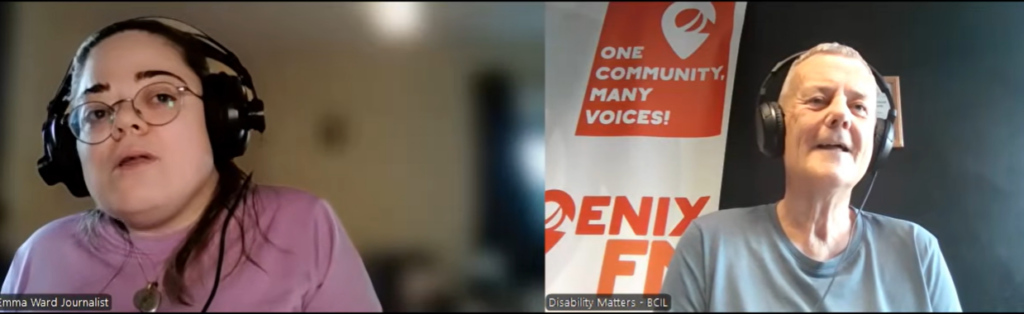
In a powerful and inspiring interview on Disability Matters, John Comiskey speaks with Emma Ward, a journalist, podcaster, public speaker, disability advocate and wheelchair user.
Emma was born in 2002 with a rare condition called Hurler syndrome (MPS I). From a young age, she underwent numerous surgeries and medical treatments, including a stem cell bone marrow transplant in 2003. She also developed scoliosis and had several surgeries throughout childhood. At the age of 11, Emma became a full-time wheelchair user, and in January 2024 she underwent a hip replacement.
But Emma’s disability is only one part of her story.
She is also incredibly proud of her identity as an Irish Traveller and speaks passionately about the importance of culture, family and representation.
Growing Up Disabled
Emma describes her childhood as one filled with hospitals and surgeries, but also with a strong determination to learn and participate in mainstream education.
She remembers that primary school could be difficult because some teachers underestimated what she was capable of.
“I have a disability, but that does not affect the way I learn.”
For Emma, having a physical disability should never have meant having lower expectations placed upon her.
“My disability is only a physical thing. It affects my hip, so I can’t walk. But that doesn’t give you the right to not teach me properly.”
Her confidence grew during secondary school, where she became increasingly comfortable advocating for herself and making sure that people understood that her wheelchair did not define her abilities.
Emma describes herself as someone who has always loved learning, reading and communication. Those interests eventually led her towards journalism.
From Hospital Rooms to Journalism
Emma says her path into journalism happened almost by accident.
She had always enjoyed writing and talking to people, and her experiences in hospital gave her plenty of opportunities to listen to other people’s stories.
“I love reading. I love chatting. And I love listening to people.”
Her first major published story came in 2022, when she wrote about her grandmother, Kathleen Moore.
Emma wanted to preserve her grandmother’s memories, but as she wrote, she realised that her story deserved to be shared more widely.
“People deserve to hear her story. Because she was just an incredible, incredible woman.”
The story was published by the Galway Advertiser and was warmly received by readers. For Emma, it became an important moment in her journey as a journalist.
She says she was initially nervous because of the way Irish Travellers are sometimes represented in the media.
“I have a very thick skin about myself. People can say anything they want about me. But about the people I love, I’d be very, very protective.”
Her grandmother’s story highlighted strength, resilience and the importance of family.
Emma says that her grandmother’s attitude towards life continues to influence her:
“She was like, I did what I had to do. I just pushed on and did everything.”
A Proud Irish Traveller
Emma speaks with enormous pride about being both disabled and an Irish Traveller.
She describes being a disabled Traveller as a unique perspective that is rarely represented in the media.
Her connection to her Traveller heritage was particularly strengthened by her grandmother, who lived through a very different Ireland.
Emma recalls hearing stories about her grandmother living on the side of the road and raising a family.
What stayed with Emma most was the sense of community.
“Travellers just gather around each other and help each other when times are hard. And that’s what I love about being a Traveller.”
For Emma, identity and community are not simply things to talk about — they are part of what gives her the confidence to speak publicly.
Finding Her Voice Through Advocacy
Emma’s journey into disability activism began to develop more strongly in recent years.
In October 2023, during the IWA PA strike, Emma wrote publicly about how the disruption to personal assistant services was affecting her.
She explains that although she has a supportive family, independence remains incredibly important to her.
“I have a great family, don’t get me wrong. They do everything for me, but I am a young woman who loves her independence.”
Her writing attracted attention within the disability community, and Emma began to receive more opportunities to speak about disability rights and accessibility.
Her approach is straightforward: speak up when something is wrong, but do so respectfully.
“I will say what I want in a nice and mannerly profession.”
She is particularly passionate about challenging negative attitudes towards both disability and Traveller communities.
“I would call out things that I think are wrong. I’ll say it in a nice way, but I won’t let people get away with talking bad about disability stuff or Traveller stuff.”
Why Representation Matters
One of the most powerful parts of Emma’s story is her discussion of representation.
Growing up, she rarely saw wheelchair users represented in mainstream media.
“I never grew up seeing people like me in the media.”
She remembers seeing very few wheelchair users on television and almost no representation in magazines.
That lack of visibility affected how she felt about herself and her wheelchair.
A turning point came when photographer Martin Beanz Ward invited her to participate in a photography project in 2022.
Emma says she was initially self-conscious, but decided that if she wanted to become a public speaker, she needed to step outside her comfort zone.
“If you want to become a public speaker, you’re going to have to get out of your comfort zone. You’re going to have to get uncomfortable.”
The experience helped Emma become more comfortable with being visible.
Today, one of her biggest motivations is making sure that young disabled people have someone they can look to.
“I don’t want the next generation of wheelchair users or people with disabilities to grow up feeling like they don’t belong in a world.”
And her message is simple:
“If Emma Ward can do whatever she’s been doing, so can we.”
Speaking to Decision-Makers
Emma has also brought her experiences directly into conversations with politicians and decision-makers.
She describes one particularly memorable event involving Irish Travellers at the Oireachtas, where she spoke about her experience as a disabled Traveller.
Although she was nervous, she decided to take the opportunity.
“The one thing is I doubt myself, but I will take the opportunity.”
The experience became one of the most powerful moments of her life.
She remembers seeing TDs and Senators listening to the speakers and engaging with their experiences.
“I had never felt more powerful in a room that day because it was all Travellers and so many different TDs and Senators came in and they listened to us.”
Emma believes that disabled people and minority communities must be given the opportunity to speak for themselves.
“We’re the ones who know what we need. We just need a little extra support and we just need people to trust us to know that.”
From Politics to Electric Picnic
Emma’s advocacy has also taken her to unexpected places — including Electric Picnic.
She has spoken at the festival about disability and Traveller representation, including work with Amnesty Ireland and groups of Traveller women.
For Emma, the significance was not simply being invited to a major festival. It was the opportunity to bring disability and Traveller voices into a space where they might not otherwise be heard.
She was also impressed by the accessibility she experienced at the festival.
“They made sure to have the ramp, which I didn’t have to ask them for. It was just, they did it.”
For a wheelchair user, she says, that kind of proactive approach makes a real difference.
Giving People a Platform
Emma’s passion for storytelling has also led her to launch her own podcast, What’s Happening with Emma.
The podcast grew from a simple idea: give people a platform to tell stories that might not otherwise receive attention in mainstream media.
“It’s just people I believe that deserve to have a platform to share their stories, the ones that don’t really get to share their stories in normal mainstream media.”
Emma also records solo episodes where she talks about current affairs, her own experiences and issues that matter to her.
The podcast has already attracted hundreds of listeners, and Emma hopes to continue developing it.
A Young Advocate with a Clear Purpose
Despite everything she does, Emma says she doesn’t really know where she finds the time.
Her answer is refreshingly simple:
“I do it because I love it. I make the time.”
Her motivation comes particularly from her six-year-old nephew, Patrick, who has the same condition as Emma.
She wants him to grow up in a world where disability does not mean having to plan every aspect of life around barriers.
“I want him to grow up in a world where he doesn’t have to pre-plan every step of his life. Like I have to.”
Emma is also honest about the importance of taking time for herself, spending time with family and friends and recognising when she needs to rest.
But her passion for advocacy remains strong.
For Emma, the goal is not simply to speak about disability. It is to change perceptions, challenge barriers and make sure that young disabled people know that they belong.
Her story is a powerful reminder that representation matters, lived experience matters, and sometimes one person’s decision to speak up can create space for many others to do the same.
You can follow Emma on Instagram at @emmawardjournalist.
This interview aired on Disability Matters on 92.5 Phoenix FM, a programme produced by Blanchardstown Centre for Independent Living (BCIL).
Tune in to Disability Matters Thursdays at 4PM | Repeats: Mon 3AM, Tue 3AM & 7AM | Also available on Mixcloud and on bcil.ie/radio.
Compiled by Valentyna Hordiichuk