
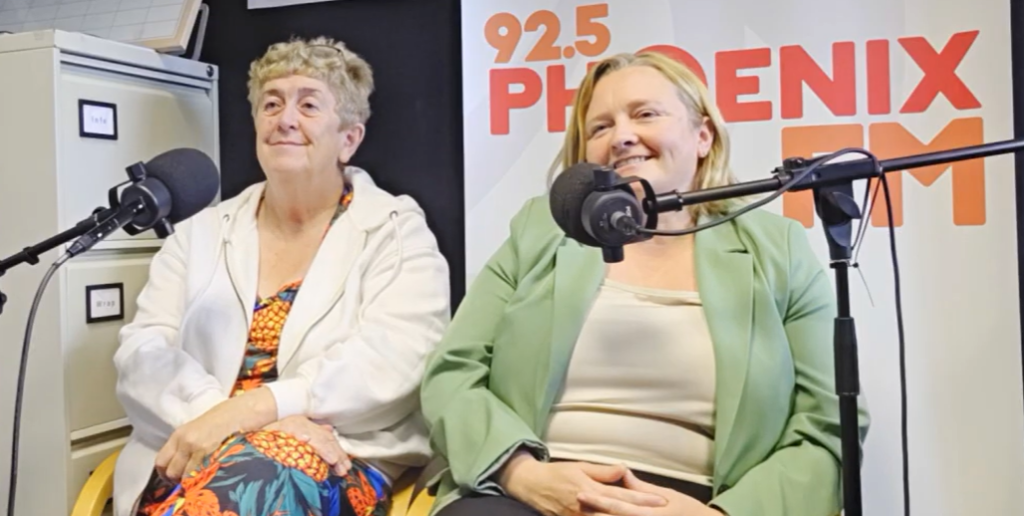
Antoinette Tierney and Geraldine Rooney reflect on BCIL’s services, advocacy and the importance of supporting people to live independently
For more than three decades, Blanchardstown Centre for Independent Living (BCIL) has been working to support people with disabilities to live independently, remain connected to their communities and have greater choice over their own lives.
In a special Disability Matters interview, host John Comiskey speaks with BCIL Manager Antoinette Tierney and Development Officer Geraldine Rooney about the organisation’s work, the services it provides, the importance of peer support and advocacy, and the challenges facing people with disabilities in the community.
The conversation also provides an opportunity to look back at BCIL’s development and consider what is needed to continue supporting people into the future.
Supporting people to live independently
Antoinette explains that her role involves overseeing the day-to-day running of BCIL’s services as well as the Community Employment Scheme.
One of the organisation’s most important services is transport.
“At the moment, the main one seems to be the transport.”
BCIL currently has five vehicles on the road, helping people attend hospital and doctor’s appointments, access day services and participate in social activities.
Four of the vehicles are wheelchair accessible, while another vehicle provides transport for people who are more mobile.
The transport service is supported by drivers and driver’s assistants, helping people travel safely and comfortably.
Accessibility and safety are central to the service. Driver retraining is also planned, including training around wheelchair restraints, seatbelts, wheelchair sizes, vehicle safety, speed and road conditions.
“It’s all about accessibility.”
Demand for transport continues to grow
The demand for BCIL’s services remains extremely high.
When John asks whether the organisation is busy, Antoinette’s answer is immediate:
“Very busy.”
She explains that BCIL has a waiting list and that even with a much larger fleet of vehicles, demand would remain strong.
However, the organisation is determined not to expand at the expense of the quality of its services.
“We don’t want to dilute service, so we’re kind of making sure that we keep a service that’s the highest standard.”
At the time of the interview, BCIL was supporting around 500 people across its services, including transport, maintenance and home support. The waiting list had already grown to more than 44 people.
More than transport
While transport is a major part of BCIL’s work, it is only one part of a much broader range of services.
The organisation also provides home support, helping people in their own homes.
Antoinette explains that this is not a traditional cleaning service. Instead, the aim is to provide practical assistance that helps people manage everyday life.
BCIL also has Information Officers, who assist people with paperwork and navigating different issues.
There is also a media team, the Disability Matters radio programme, volunteers, peer support and the wider network of people who contribute to BCIL’s work.
Together, these services reflect the organisation’s broader philosophy: supporting people to have choice and control over their own lives.
What does independent living actually mean?
Geraldine explains that there can sometimes be a misunderstanding about what a Centre for Independent Living actually does.
“People think that because we’re a centre for independent living that we’re like a day service and people come here, but we’re not.”
Independent living is a philosophy based on choice, autonomy and control.
For one person, independence might mean going to work every day and living in the community as a wheelchair user.
For another person, it might mean choosing which activities they want to participate in, deciding what they want to do during their day or simply choosing when they want to eat.
As Geraldine puts it:
“There are different levels of independence, but as long as people have the ability to choose that, it’s all about choice.”
That idea of choice is at the heart of BCIL’s work.
A pan-disability organisation
BCIL describes itself as a pan-disability organisation, supporting people with different disabilities and needs.
The organisation has a mixture of staff, Community Employment participants, volunteers, board members and people with lived experience who contribute to its work.
BCIL also works with other disability and health organisations and engages with professionals including social workers, doctors and nurses.
For Geraldine, the organisation’s role is ultimately about ensuring that people with disabilities are supported to live the lives they choose.
“We are there to support people to be independent and stay in their own homes as long as possible.”
Nearly 20 years of peer support
One of the most established parts of BCIL’s work is its peer support group, which has been running for nearly 20 years.
The group meets on the last Thursday of every month at the library.
Around 15 people attend on average, although people can come regularly or simply join when they need support or advice.
The group is not only about social connection. Members are actively involved in access audits, advocacy and lobbying, helping ensure that disability issues remain visible within the local community.
At the time of the interview, one of the group’s major areas of focus was the cost of disability and ensuring that the disability voice is heard in discussions around government budgets.
“It’s good to have that disability voice at the table because sometimes you feel it can be overlooked.”
The group also demonstrates the value of lived experience.
Someone facing a particular problem may find that another wheelchair user or person with a disability has already experienced something similar and can suggest a practical solution.
As Geraldine explains, sometimes:
“The best learning is off someone with the lived experience.”
And the invitation to people who might feel isolated is wonderfully simple:
“We always have the kettle on.”
People can come along with questions, concerns or simply for some company.
“Literally just come down and join us if you have any issues, queries or maybe just even it’s about reducing isolation.”
The cost of disability
The interview also turns to one of the major issues facing people with disabilities: the additional cost of living with a disability.
Antoinette points out that people can face thousands of euro in additional costs each year.
For example, someone who uses a wheelchair may need to keep their home warmer, while accessible transport, equipment, maintenance and other disability-related costs can add significantly to household expenses.
“There are people out there who are actually afraid to turn on the heating.”
For BCIL, this is not simply an economic issue. It is about whether people can afford to live safely and participate fully in their communities.
The origins of the independent living movement
The conversation also looks back at the origins of BCIL and the independent living movement.
Geraldine explains that the movement was inspired by the idea that people with disabilities should have autonomy and choice.
The concept developed internationally before being brought to Ireland, eventually leading to the development of Centres for Independent Living and personal assistance services.
A personal assistant is not simply there to do things for a person.
“A personal assistance person is the arms and legs of the person with the disability. And then the member would be the leader.”
That distinction is important.
The person receiving support remains the decision-maker.
Ordinary lives, with the right support
Perhaps one of the most powerful messages in the interview is that people with disabilities are not asking to be treated as extraordinary.
They simply want the opportunity to live ordinary lives.
“They just want to be ordinary people living ordinary lives and doing it to the best of their ability.”
The barriers, Geraldine says, are often created by society itself — inaccessible buildings, stairs without ramps and systems that have not been designed with everyone in mind.
“The barriers are societal.”
Greater visibility has helped change attitudes.
People with disabilities are increasingly visible in workplaces, communities, education and public life.
“When you see it, you can be it.”
The people behind BCIL
The interview also celebrates the staff and volunteers who make BCIL’s work possible.
Antoinette says the organisation is proud of the people who work with it and of the strong community around the centre.
Some staff members have joined through the Community Employment Scheme and gone on to develop new skills and careers.
Both Antoinette and Geraldine have their own experience of Community Employment, and they speak positively about the opportunities it can provide.
“It’s all about the service for the people.”
For Antoinette, one of the most rewarding aspects is seeing people develop and move forward.
“We have amazing staff at the moment.”
She also acknowledges that losing experienced staff can be difficult because Community Employment placements have limits, meaning organisations sometimes have to say goodbye to people they would like to keep.
Nevertheless, many former staff members go on to do wonderful things.
Looking towards the future
BCIL would like to expand its services, but funding remains a major consideration.
Antoinette explains that the organisation is currently operating with limited funding while facing increasing costs, including fuel and insurance.
At the same time, demand continues to rise.
The challenge is to grow while maintaining the standard of service that people depend upon.
“We’ll continue to do the best service for what we can, what we have.”
The commitment remains to provide the highest possible standard of service while continuing to advocate for greater support and resources.
Keeping disability at the table
For both Antoinette and Geraldine, BCIL’s role goes beyond providing individual services.
It is also about advocacy, visibility and ensuring that disability remains part of the wider community conversation.
Whether through the peer support group, community events, the Disability Matters radio programme, social media or direct advocacy, BCIL aims to make sure that people with disabilities have a voice.
The organisation will also be holding an event on 14 October 2026 connected with the International Day for the Eradication of Poverty, bringing different community organisations together to share information about services and support.
As Antoinette explains, information itself can make a difference:
“It’s by information, you know, spreading information that people find out things.”
32 years of independent living
BCIL has been operating since 1994, marking more than three decades of work in the community.
Throughout that time, the central philosophy has remained remarkably consistent: people with disabilities should have choice, autonomy and the support they need to live their own lives.
This special Disability Matters conversation with Antoinette Tierney and Geraldine Rooney offers listeners a chance to look behind the scenes at the organisation — the services, the people, the challenges and the values that continue to drive BCIL forward.
At its heart, the message is simple: People with disabilities have their own voices, their own choices and their own lives. Sometimes, they simply need the right support to make those choices possible.
This interview aired on Disability Matters on 92.5 Phoenix FM, a programme produced by Blanchardstown Centre for Independent Living (BCIL).
Tune in to Disability Matters Thursdays at 4PM | Repeats: Mon 3AM, Tue 3AM & 7AM | Also available on Mixcloud and on bcil.ie/radio.