
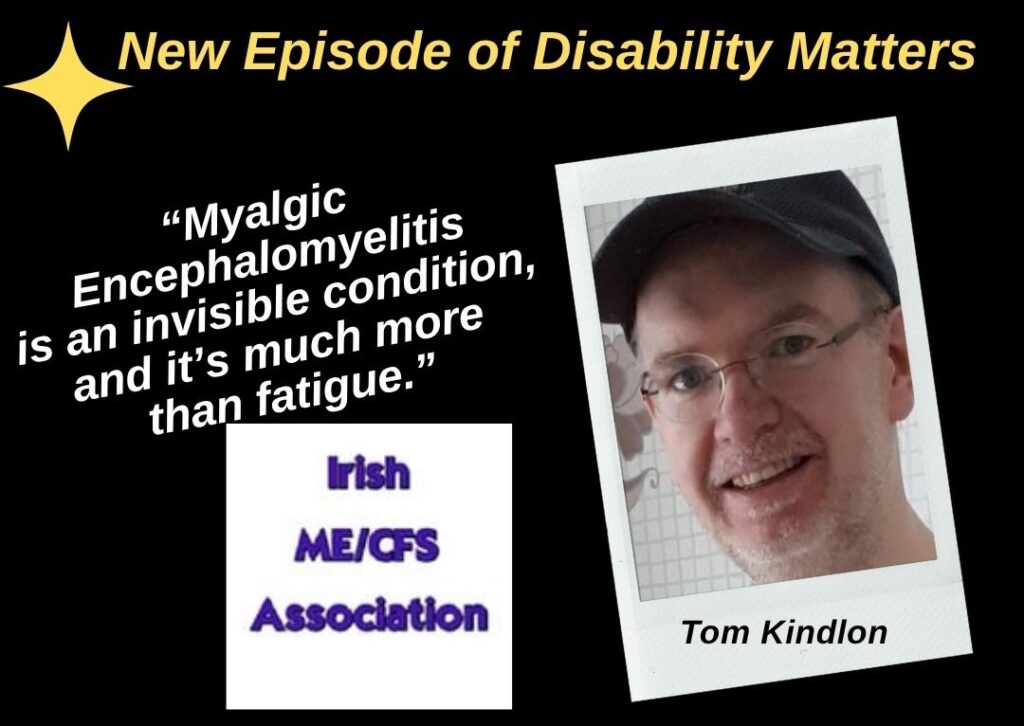
For people living with Myalgic Encephalomyelitis/Chronic Fatigue Syndrome (ME/CFS), even everyday activities can have a significant impact on their health. Yet the condition is often misunderstood, diagnosis can take years, and access to appropriate medical care and support remains a challenge.
In this episode of Disability Matters, interviewers Kirsten Ampeloquio and Adam Cirkic speak with Tom Kindlon, a long-standing advocate with the Irish ME/CFS Association, about the realities of living with the condition, his own experience of becoming ill as a teenager, and the changes he would like to see for people affected by ME/CFS in Ireland.
Tom explains why it is important to recognise ME/CFS as a serious and complex medical condition – not simply tiredness – and why greater awareness, research and understanding are urgently needed.
Understanding ME/CFS: More Than Just Fatigue
ME/CFS stands for Myalgic Encephalomyelitis/Chronic Fatigue Syndrome. Although it is classified by the World Health Organization as a neurological condition, Tom explains that it can affect several different systems within the body.
People can experience a wide range of symptoms, including post-exertional malaise, sleep disturbances, difficulties with concentration, muscle and joint pain, headaches, sore throats and sensitivity to light and sound. Some people also experience orthostatic intolerance, which means difficulty tolerating an upright position – and, in some cases, even sitting upright can be challenging.
Tom points out that the terminology itself has sometimes been a source of debate. The term “chronic fatigue syndrome” can be misleading because it focuses on fatigue, while the illness involves many other symptoms and can have a profound impact on daily life.
As he explains, it is important that people understand the seriousness of the condition rather than dismissing it as ordinary tiredness.
What Is Post-Exertional Malaise?
One of the most important symptoms associated with ME/CFS is post-exertional malaise (PEM).
In everyday terms, PEM means that a person’s symptoms become worse after physical, mental or other exertion. What makes it particularly difficult to understand is that the reaction may not happen immediately.
Tom explains that someone might carry out an activity one day but only experience a significant worsening of symptoms 12, 24 or even 48 hours later. The effects can then last for days, weeks or, in some cases, months.
Even relatively minor activities can trigger this response. An outing, a social event or a task that might seem manageable to someone without the condition can have serious consequences for a person with ME/CFS.
This delayed reaction is one reason why the illness can be so difficult for others to understand. Someone may appear well enough to take part in an activity, but people do not see the rest they may have needed beforehand or the symptoms they experience afterwards.
Tom’s Personal Journey: Becoming Ill as a Teenager
Tom’s own experience with ME/CFS began in 1989, when he was still a teenager.
Before becoming ill, he was very active and enjoyed a range of sports, including rugby, football, tennis and cricket. Following an infection during a school trip, however, he never fully recovered.
At first, he noticed that he could no longer play sports as he had before. He began experiencing problems with concentration, sleep disturbances, headaches and other symptoms. Over time, his health deteriorated further.
Despite struggling, Tom continued with his education and went on to study mathematics at Trinity College Dublin. He eventually had to take a year out because he was finding the demands of his course increasingly difficult to manage.
He also recalls being encouraged by doctors and physiotherapists to exercise more. However, this made his condition worse.
It took five years to receive a diagnosis.
Looking back, Tom believes that an earlier diagnosis could have made a significant difference. Without understanding what was happening, he was expected to continue meeting the demands of school, college and everyday life as though he were healthy.
He explains that he often had to give up his social life simply to try to keep up with his studies.
His experience highlights the importance of recognising the condition early and ensuring that people receive appropriate advice about managing their symptoms.
Living with an Invisible and Fluctuating Condition
One of the biggest challenges for people with ME/CFS is that it is often an invisible illness.
A person may look well and appear able to participate in everyday activities. However, their appearance does not reflect the effort involved or the consequences that may follow.
Tom explains that someone might attend a social event after spending several days resting, only to experience a significant worsening of symptoms once they return home.
The condition can also fluctuate from day to day. What someone manages today may not be possible tomorrow.
This can lead to misunderstandings, particularly when others see only what a person can do rather than the limitations and recovery time that are not visible.
Tom emphasises that ME/CFS involves much more than fatigue. It can affect concentration, sleep, mobility, the ability to remain upright and almost every aspect of daily life.
The Work of the Irish ME/CFS Association
Tom has been involved with the Irish ME/CFS Association for many years. The organisation is a small, volunteer-led group made up of people living with the condition and those caring for someone affected by it.
Its work includes providing information, responding to enquiries, organising support groups, raising awareness and supporting research.
The Association publishes a newsletter three times a year and also sends regular email updates. It organises support group meetings, including a monthly meeting in Dublin 15, as well as talks with medical experts and speakers.
In May, the Association welcomed a speaker from the UK and organised talks in Dublin, Cork, Limerick, Galway and Sligo.
Tom explains that the organisation tries to help people find reliable information and navigate the many questions that arise after diagnosis – or while they are still trying to understand their symptoms.
As a volunteer-led organisation, its resources are limited, but it continues to provide support wherever possible.
Research: Understanding the Biological Basis of ME/CFS
Research into ME/CFS has identified a range of possible abnormalities involving the immune system, the nervous system, blood flow, energy production and responses to exercise. However, Tom says that progress has been slow, and findings from individual studies are not always consistently replicated.
He highlights research into orthostatic intolerance, where studies have examined changes in blood flow to the brain when people move into an upright position.
Another important area is the relationship between infections and the development of ME/CFS. Tom explains that research following groups of people after particular infections has found that some go on to develop the condition.
He also points to the growing interest in Long COVID research. This has brought additional funding, researchers and attention to illnesses involving persistent symptoms following infection.
Tom hopes that this wider research effort will also help advance understanding of ME/CFS.
There is a need not only to understand the biological mechanisms behind the illness, but also to develop reliable diagnostic tests, effective treatments and biomarkers that can help researchers measure changes in the condition.
The Challenges of Diagnosis and Medical Care in Ireland
A major concern raised during the interview is the lack of specialist public clinical services for ME/CFS in Ireland.
Tom explains that there is no dedicated public ME/CFS clinic and that knowledge of the condition can vary considerably among healthcare professionals.
Some patients face long waiting lists, only to find that the doctor they eventually see may not have sufficient experience with the illness. Others may struggle to access a diagnosis or appropriate ongoing care.
The situation can be particularly difficult for people who are severely affected, housebound or bedbound. Travelling to appointments, sitting upright for long periods or attending an emergency department can be extremely challenging.
Tom also highlights the difficulties some people face when trying to access home support and financial assistance. People with ME/CFS may find themselves falling between services, particularly when support systems are not designed around their needs.
For many, this can make independent living extremely difficult.
A National Clinical Guideline: An Important Opportunity
Tom welcomes the funding announced in 2025 for the development of Ireland’s first national clinical guideline for ME/CFS.
He sees this as a significant opportunity to improve how the condition is recognised, diagnosed and managed.
He hopes the guideline will give doctors clearer advice on diagnosis and care, explain the risks of recommending inappropriate exercise, and provide better guidance on supporting people with severe ME/CFS.
He also stresses the importance of recognising that children and teenagers can develop the condition.
For people who are severely affected, care may need to be provided at home, with particular attention to their sensitivity to activity and stimulation.
Tom hopes that a national guideline will encourage more consistent understanding among healthcare professionals and help patients receive the care they need.
Why People with Lived Experience Must Be Part of Research
Another important topic in the conversation is the role of people with ME/CFS in shaping medical research.
Tom believes that patients and carers can make a valuable contribution to research design. They understand the practical challenges of living with the condition and can help researchers develop studies that are more accessible to participants.
For example, research appointments may need to allow people to lie down, take breaks or divide assessments into shorter sessions. Without these adjustments, some people may be unable to participate.
Tom also believes that participants should, where possible, be able to receive information about their own results.
He points out that people living with the condition spend a great deal of time thinking about their symptoms and experiences. Their insights can help researchers ask better questions and design more useful studies.
Including people with lived experience is therefore not simply about consultation – it can help improve the quality and relevance of research.
What Needs to Change for People with ME/CFS in Ireland?
Looking towards the future, Tom identifies several priorities.
These include establishing specialist public clinical services, improving medical education, providing better home support for people who are severely affected, and increasing financial assistance for those facing the additional costs associated with living with the condition.
He would also like to see more research taking place in Ireland, alongside continued international research and collaboration.
For Tom, one of the most important changes would be ensuring that people with ME/CFS are taken seriously and that their needs are recognised throughout the healthcare and support systems.
Finding Information and Support
The Irish ME/CFS Association encourages people affected by the condition, including family members and carers, to get in touch with questions.
Although the Association is volunteer-led and its website is still being developed, it can help people access information from Ireland and other countries, including guidance on disability payments and available support.
Tom also mentions Irish online support groups and the UK ME Association as useful sources of information.
Contact the Irish ME/CFS Association:
- Website: https://irishmecfs.org/
- Email: info@irishmecfs.org
- Voicemail: 01 235 0965
The voicemail is not a live telephone service, but volunteers aim to respond to enquiries as soon as they can.
Tom Kindlon’s conversation is an important reminder that ME/CFS is a complex and often misunderstood condition. Behind the symptoms that others cannot see are people facing real barriers to healthcare, education, employment, social participation and independent living.
Greater awareness, better medical understanding and meaningful support can make a difference.
This interview aired on Disability Matters on 92.5 Phoenix FM, a programme produced by Blanchardstown Centre for Independent Living (BCIL).
Tune in to Disability Matters Thursdays at 4PM | Repeats: Mon 3AM, Tue 3AM & 7AM | Also available on Mixcloud and on bcil.ie/radio.